
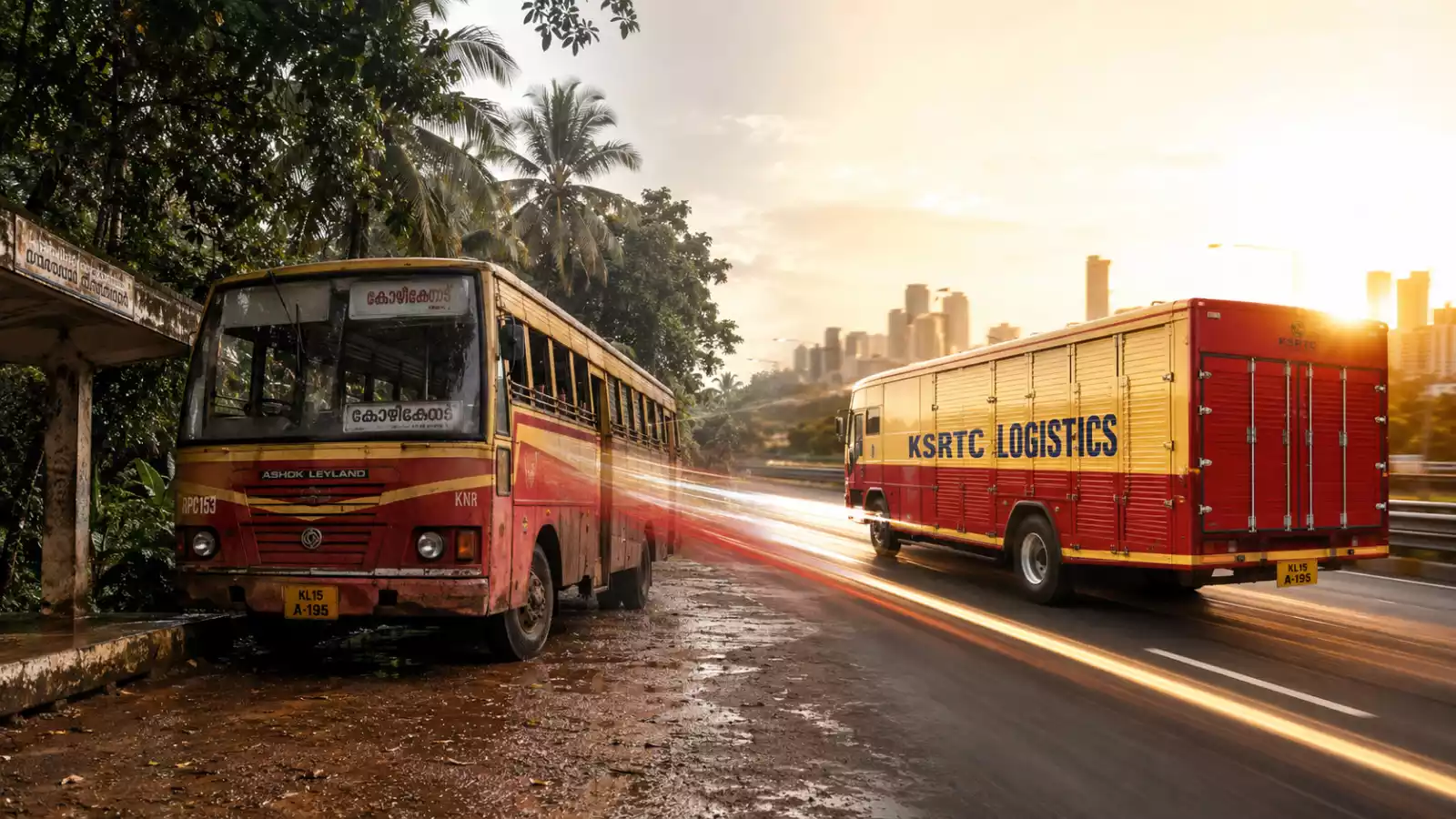
KSRTC Logistics: Successes, Challenges, and Lessons – A Case Study.
Introduction
Logistics plays a vital role in the economy by ensuring the efficient movement of goods and services from one place to another. As new businesses emerge and online commerce continues to grow, the demand for fast, reliable, and cost-effective logistics services has increased significantly. The rapid expansion of e-commerce, retail, and supply chain management has further accelerated the need for efficient logistics solutions. While private logistics companies dominate the industry, public sector organizations have also explored innovative ways to utilize their existing infrastructure to meet this growing demand.
In this context, the Kerala State Road Transport Corporation (KSRTC) launched KSRTC Logistics on 6 October 2020. The service was inaugurated by the then Chief Minister of Kerala, Shri Pinarayi Vijayan, during the COVID-19 pandemic with the objective of generating additional revenue for KSRTC while making effective use of its extensive bus network. Along with the cargo service, the KSRTC mobile application was also introduced.
KSRTC Logistics enables individuals, businesses, hospitals, and government organizations to transport parcels, documents, medicines, and commercial goods across Kerala. The service has been particularly beneficial in rural and remote areas where KSRTC buses provide regular connectivity. It was launched with the promise of “Delivery Anywhere in Kerala within 16 Hours,” offering customers an affordable and reliable logistics solution.
The primary objective of KSRTC Logistics is to provide affordable, reliable, and efficient logistics services while maximizing the utilization of existing transportation infrastructure. By leveraging its well-established bus network, KSRTC has developed a sustainable business model that benefits both customers and the corporation.
Today, KSRTC Logistics serves individuals, businesses, retailers, educational institutions, hospitals, and government organizations by offering secure parcel transportation with extensive statewide coverage. The initiative demonstrates how a public sector organization can diversify its services, improve operational efficiency, and create additional value through innovation.
Objectives of KSRTC Logistics
The major objectives of KSRTC Logistics are:
- Generate additional revenue for KSRTC.
- Provide affordable logistics services.
- Maximize the utilization of existing transportation resources.
- Ensure fast and reliable parcel delivery.
- Expand logistics access across Kerala.
- Support businesses and e-commerce operations.
- Improve customer satisfaction.
- Promote sustainable transportation through efficient resource utilization.
Services Offered by KSRTC Logistics
KSRTC Logistics provides safe, reliable, and affordable parcel transportation by utilizing the corporation’s extensive passenger bus network. The major services include:
- Parcel Delivery Services
- Document and Courier Services
- Commercial Cargo Transportation
- E-commerce Logistics Support
- Transportation of Essential Goods
- Business-to-Business (B2B) Parcel Services
- Statewide Parcel Network
Key Features
- Affordable transportation charges.
- Wide coverage across Kerala through KSRTC’s bus network.
- Safe and secure parcel handling.
- Same-day or next-day delivery on many routes.
- Convenient booking through selected KSRTC depots.
- Suitable for individuals, businesses, educational institutions, hospitals, and government organizations.
- Reliable transportation through scheduled bus services.
5. Business Model of KSRTC Logistics
KSRTC Logistics follows an asset-light and resource-optimization business model by utilizing the existing passenger bus network instead of investing in a separate fleet of cargo vehicles. The available luggage space in scheduled buses is efficiently used for transporting parcels, enabling KSRTC to generate additional revenue while keeping operational costs low.
Business Model Overview
Customers book parcels at designated KSRTC depots, where consignments are registered, weighed, and charged according to KSRTC’s pricing structure. Parcels are transported in the luggage compartments of passenger buses and delivered to the destination depot, where recipients collect them after verification.
Key Components
Value Proposition
- Affordable parcel transportation
- Fast delivery through scheduled bus services
- Extensive statewide network
- Safe and reliable parcel handling
- Easy accessibility through KSRTC depots
Customer Segments
- Individual customers
- Small and Medium Enterprises (SMEs)
- Retailers and wholesalers
- E-commerce businesses
- Government departments
- Educational institutions
- Hospitals and healthcare providers
Revenue Streams
- Parcel booking charges
- Cargo transportation fees
- Commercial consignment services
- Bulk logistics contracts
Key Resources
- KSRTC bus fleet
- Statewide depot network
- Experienced workforce
- Existing transport infrastructure
- Digital booking systems
Key Activities
- Parcel booking
- Parcel registration
- Weighing and pricing
- Loading and unloading
- Transportation
- Customer support
- Delivery management
Key Partners
- Government agencies
- Business organizations
- E-commerce companies
- Local traders
- Transport service providers
Cost Structure
- Staff salaries
- Parcel handling
- Technology maintenance
- Administrative expenses
- Depot operations
- Insurance and safety costs
Operational Flow
- Customer books the parcel at a KSRTC logistics counter.
- The parcel is inspected and weighed.
- Transportation charges are calculated.
- The parcel is loaded into a scheduled KSRTC bus.
- It is transported to the destination depot.
- The recipient is notified (where applicable).
- The parcel is verified and delivered.
Business Model Advantages
- Utilizes existing infrastructure efficiently.
- Generates additional revenue.
- Low operating costs.
- Extensive statewide coverage.
- Affordable logistics solutions.
- Environmentally sustainable transportation model.
Limitations
- Limited cargo space.
- Dependence on passenger bus schedules.
- Lack of comprehensive door-to-door delivery.
- Strong competition from private logistics companies.
- Growing demand for advanced digital services and parcel tracking.
Overall, KSRTC Logistics demonstrates how a public transport organization can successfully diversify its operations through effective resource utilization and innovation.
Barriers to the Growth of KSRTC Logistics
Despite its promising beginning, KSRTC Logistics has encountered several operational and administrative challenges.
One of the major setbacks occurred when the logistics operations were outsourced to the Andhra Pradesh-based company Sinku Solutions. Although the service had been managed by trained KSRTC employees, the operations were handed over to Sinku Solutions in September 2024 during the tenure of the then Transport Minister K. B. Ganesh Kumar. The company was awarded a five-year contract through a tender process on a commission basis.
However, the outsourcing arrangement resulted in several operational concerns and management disputes. Reports indicated that the partnership failed to achieve the expected outcomes, leading to uncertainty regarding the future of the service. KSRTC reportedly instructed logistics centres to stop accepting new parcel bookings while completing deliveries already in transit, creating concerns about the continuity of the service.
Other challenges include:
- Strong competition from private courier companies.
- Limited digital infrastructure.
- Dependence on passenger bus schedules.
- Limited cargo capacity.
- Financial constraints.
- Lack of widespread public awareness.
- Operational coordination issues.
To ensure sustainable growth, KSRTC Logistics should strengthen its digital infrastructure, improve customer service, expand marketing initiatives, invest in modern logistics technologies, and adopt a transparent and efficient management system.
Summary
KSRTC Logistics is an innovative public-sector logistics initiative launched by the Kerala State Road Transport Corporation on 6 October 2020. By utilizing the unused luggage space in passenger buses, the service provides affordable and efficient parcel transportation across Kerala while generating additional revenue for KSRTC.
The case study highlights the objectives, services, business model, operational process, advantages, and challenges of KSRTC Logistics. The initiative demonstrates how existing public transportation infrastructure can be transformed into a sustainable logistics network through effective resource utilization and operational innovation.
Although KSRTC Logistics has achieved considerable success, it continues to face challenges such as competition from private logistics providers, limited digital capabilities, operational constraints, and administrative issues. The outsourcing of logistics operations also created uncertainty regarding the service’s continuity and effectiveness.
Overall, KSRTC Logistics serves as an excellent example of innovation in the public sector. With continued investment in technology, customer-centric services, operational efficiency, and strategic management, the initiative has significant potential to strengthen its position as one of Kerala’s most accessible and cost-effective logistics service providers.